


PSLE Chinese Oral Topics: Common Themes and Sample Answers
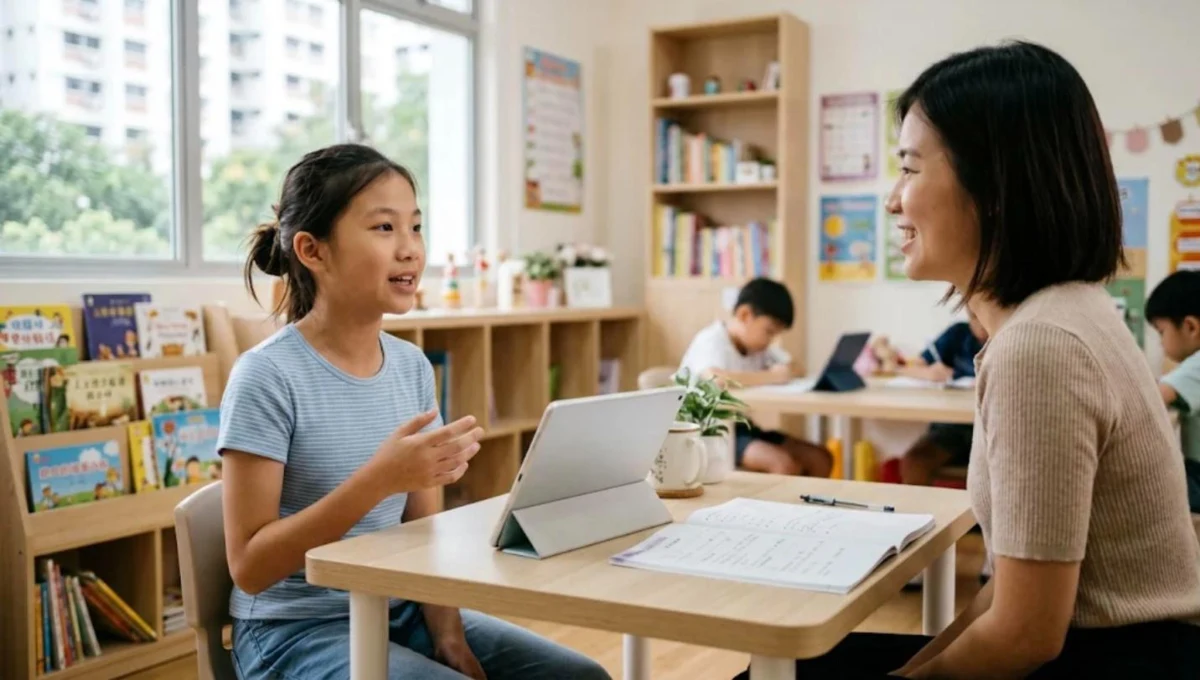
The most common PSLE Chinese oral topics are values your child meets in daily life: saving resources, helping others, being considerate and keeping the environment clean, plus related themes such as racial harmony and caring for the elderly. In the video-based conversation (视频会话), the examiner usually asks your child to describe the video, share a personal experience and give an opinion with reasons. As a result, preparing for these themes, with a clear answer structure and topic vocabulary, makes the exam far less stressful. This guide uses examples from our own Chinese oral workbook at Speech Academy Asia.
How Does the Video Conversation Work?
The PSLE Chinese oral has two parts: Reading Aloud (朗读) and the video-based conversation (视频会话). Together, they make up 50 marks, or 25% of the Chinese grade. Before entering the exam room, students get 10 minutes to read the passage and watch the video.
Then, during the conversation, the examiner usually asks three kinds of questions. Knowing them in advance helps your child prepare for any of the PSLE Chinese oral topics:
| Question type | Example | What a good answer does |
|---|---|---|
| Describe the video | 说一说在录像中你看到了什么? | Retells what happened using 六何法 (when, where, who, what, why, how) |
| Share an experience | 你曾经做过或看过哪些乐于助人的事? | Tells a short personal story with a beginning, middle and end |
| Give an opinion | 你认为节省资源重要吗?为什么? | States a clear view and gives two or three reasons, then sums up |
For the full exam format and how we teach each part, see our Chinese oral classes and workshops page.
Which PSLE Chinese Oral Topics Come Up Most Often?
Exam videos change every year, but the themes are fairly predictable. Our Primary 5 and 6 workbook groups the common PSLE Chinese oral topics into four main themes, each with related topics:
| Main theme | Related topics to prepare |
|---|---|
| 节省资源 / 浪费资源 (saving or wasting resources) | 浪费食物 (food waste), saving water and electricity |
| 乐于助人 (helping others) | 邻里关系 (neighbours), 关爱老人 (caring for the elderly) |
| 为别人着想 (being considerate) | 种族和谐 (racial harmony), 遵守公共场所的规则 (rules in public places such as the MRT or library) |
| 保持环境清洁 (keeping the environment clean) | 环境保护 (protecting the environment), 归还碗碟 (returning trays) |
Because one video can link to several PSLE Chinese oral topics, it helps to prepare ideas that work across themes. For example, a story about returning your tray at a hawker centre fits both “keeping the environment clean” and “being considerate”.
How Should Your Child Answer PSLE Chinese Oral Topics?
In fact, a good answer is not about fancy idioms. Instead, it needs a clear structure, complete sentences and a personal touch. We teach three simple patterns:
- For describing the video: use 六何法 to cover when, where, who, what, why and how, then add one line about whether the behaviour was right or wrong.
- For a personal experience: start with an opening (开头) such as “我曾经看过……的事,事情是这样的:”, tell what happened in the middle (中间), then end (结尾) with what you learned.
- For an opinion: give your view first, then two or three reasons introduced with 第一, 第二 and 第三, and finish with 总的来说.
This is very similar to the PREP method (Point, Reason, Example, Point) we teach for the English oral, so bilingual students build one consistent habit.
What Does a Sample Answer Look Like?
Here is a shortened sample answer from our workbook for the opinion question on saving resources (节省资源):
“我认为节省资源非常重要,节省资源会带给我们很多好处。第一,可以保护环境。如果我们节约用水用电,可以减少污染。第二,可以节省金钱。随手关水龙头、关灯,家里的水电费就会减少。第三,可以让资源用得更久。总的来说,节省资源对我们自己、家人和地球都有好处。”
Notice how the answer states a view, gives three clear reasons with everyday examples, and ends with a summary. In English, the key idea is: saving resources protects the environment, saves money and makes resources last longer.
For a personal experience question on the same theme, a strong answer might describe seeing classmates leave a tap running in the canteen, explain how you stopped them, and end with a reflection that Singapore has limited water, so every drop counts.
Which Words and Phrases Help With PSLE Chinese Oral Topics?
Children who are stronger in English often know what they want to say but not the Chinese phrase. A small vocabulary bank for each theme makes a big difference:
| Phrase | Pinyin | Meaning |
|---|---|---|
| 爱惜粮食 | ài xī liáng shí | Cherish food |
| 节约用水 | jié yuē yòng shuǐ | Save water |
| 乐于助人 | lè yú zhù rén | Willing to help others |
| 为别人着想 | wèi bié rén zhuó xiǎng | Think of others |
| 公德心 | gōng dé xīn | Civic-mindedness |
| 和睦相处 | hé mù xiāng chǔ | Live in harmony |
| 自动归还碗碟 | zì dòng guī huán wǎn dié | Return trays on your own |
| 不乱丢垃圾 | bù luàn diū lā jī | Do not litter |
Linking words such as 首先, 比如, 因此 and 总的来说 also make answers sound more organised and fluent.
What Are Common Mistakes in the Chinese Oral?
Even well-prepared students lose marks on PSLE Chinese oral topics they know well. Watch out for these habits:
- Very short answers: one-sentence replies give the examiner little to mark. Instead, aim for a view, reasons and an example.
- Mixing in English or dialect: try to describe a forgotten word in simpler Chinese instead.
- Only describing the video: the examiner also wants your own experience and opinion.
- Reciting a memorised script: it often sounds unnatural and falls apart at the follow-up question.
- Forgetting exam etiquette: greet the examiner, give your name and candidate number, and thank them at the end.
How Can Parents Help at Home?
In general, short, regular practice works better than cramming. Pick one of the PSLE Chinese oral topics each week and try these ideas:
- Watch a short news clip or video together and ask your child to describe it using 六何法.
- Ask one opinion question at dinner, such as “你认为我们应该归还碗碟吗?”, and encourage two reasons.
- Also, keep a small notebook of useful phrases for each theme, with pinyin and English meanings.
- Record a two-minute answer on your phone and listen back together for clarity and pace.
Most of all, keep it relaxed. Children speak more naturally when practice feels like a conversation, not a test. Our earlier guide explains why starting PSLE Chinese oral preparation early helps.
How Does Speech Academy Asia Help?
Our Chinese oral classes for Primary 3 to 6 run weekly, with one 1.5-hour lesson a week during the school term, and are conducted in Chinese and cover both Reading Aloud and the video conversation, using our own workbook, 华文口语考试实用手册. For Primary 5 and 6, our one-day holiday Chinese Oral Workshop lets students practise the main PSLE Chinese oral topics under exam conditions, with feedback from trainers. Students also learn to manage nerves with Neuro Somatics™ techniques and speak with expression using our B.E.S.T Model™.
Younger children who are shy about speaking Chinese can start with our Chinese public speaking classes, and our PSLE oral classes cover the English oral too. Official exam details are published by the Singapore Examinations and Assessment Board (SEAB).
Frequently Asked Questions About PSLE Chinese Oral Topics
What topics come out for the PSLE Chinese oral?
In most years, the video-based conversation is built around everyday values and social issues. Common PSLE Chinese oral topics include saving resources, helping others, being considerate, keeping the environment clean, racial harmony, caring for the elderly and following rules in public places. The exact video is unseen, so it is better to practise the themes than to memorise one answer.
Should my child memorise model answers?
No. Use model answers to learn useful phrases and structures, then practise saying ideas in your child’s own words. Examiners ask follow-up questions, so a memorised script often falls apart. Above all, knowing the structure and vocabulary is what helps.
How many reasons should my child give for an opinion question?
Usually, two or three clear reasons are enough. Each reason should be explained briefly, ideally with a short example, and the answer should end with a summary such as 总的来说.
Can my child use English words if they forget a Chinese word?
Try not to. Mixing in English or dialect can lower the language score. If your child forgets a word, they can describe it in simpler Chinese instead. Building a topic vocabulary list in advance helps a lot.
The PSLE Chinese oral topics are predictable, even if the video is not. When your child knows the main themes, has a simple structure for each question type and keeps a small bank of useful phrases, the exam becomes a conversation they can handle with confidence. If you would like your child to practise with a trainer, book a free trial class with us.
👉 Book a Free Trial Class
📲 Call or WhatsApp: 9061 1715
📍 Visit Us: JEM, 52 Jurong Gateway Road, #06-01, Singapore 608550
📧 Email: info@speechacademyasia.com
Free Trial Registration
Empowering 10,000 Kids and Counting: Boost Your Child’s Confidence and Communication Skills with our Free Trial! Our Public Speaking programme builds vital public speaking and interview skills as well as your child's confidence. Equip your child with the ability to overcome stage fright, present themselves confidently and leave a lasting impression. Investing in these skills early can have immense long-term benefits! Register today!