


Primary 3 Chinese Oral: Reading Aloud and Picture Conversation Tips
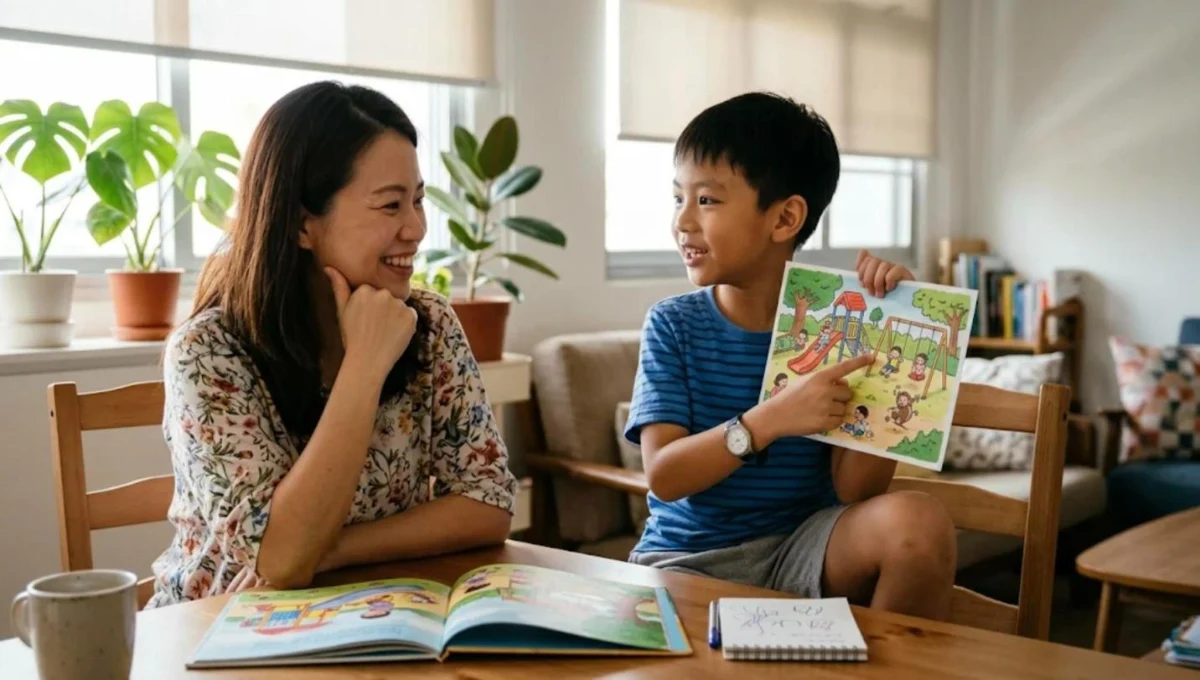
In the Primary 3 Chinese oral, children usually read a short passage aloud and then talk about a picture or short video with the examiner. To do well, your child needs to read with clear tones and pauses, describe the picture in an organised way, and answer questions in full Chinese sentences with a short opinion. Fortunately, simple tools such as position words, 六何法 and the PEEL structure make this much easier. This guide shares the approach from our own Primary 3 and 4 Chinese oral workbook at Speech Academy Asia.
What Happens in the Primary 3 Chinese Oral?
Formats vary between schools, so always check your child’s school guidelines. In general, the Primary 3 Chinese oral and the Primary 4 oral follow the same flow as the PSLE, in a simpler form:
| Part | What your child does |
|---|---|
| Preparation (about 10 minutes) | Reads the passage silently and looks at the picture or video |
| Reading Aloud (朗读) | Reads the passage clearly with correct tones, pace and pauses |
| Picture or video conversation (看图说话) | Describes the picture, then answers the examiner’s questions about it |
Before the exam, your child should also practise the etiquette: entering politely, greeting the examiner (“老师,早上好。”), giving their name and number, asking “请问可以坐下吗?” and thanking the examiner at the end.
How Can Your Child Read Aloud With Confidence?
Reading aloud is the first part of the Primary 3 Chinese oral, and our workbook gives children five simple rules for 朗读:
- Pronounce every word clearly, without adding or skipping words.
- Speak loudly enough, but not too loudly.
- Keep a steady pace that is neither too fast nor too slow.
- Pause at a comma, and pause a little longer at a full stop.
- Let your tone match the story and the feelings in it.
During practice, ask your child to circle unfamiliar words, write the pinyin beside them and say them a few times before reading the whole passage again.
How Should Your Child Describe the Picture?
At first, many children look at a busy picture and do not know where to start. Position words (方位词) solve this, because they let your child describe the picture one part at a time:
| Position | Chinese | Example sentence |
|---|---|---|
| In the centre | 正中间 | 图画的正中间有一个滑梯。 |
| In the foreground | 前景 | 图画的前景有几个正在排队的小朋友。 |
| In the background | 背景 | 图画的背景有很多游乐设施。 |
| On the left | 左边 | 在图画的左边,我看到两个女孩在荡秋千。 |
| On the right | 右边 | 图画的右边也有一个男孩在荡秋千。 |
Next, your child can use 六何法 (when, where, who, what, why, how) to explain what is happening. Finally, they should add a short comment, such as “我认为图中的小男孩这样做是不对的,因为……”. As a result, this simple three-step pattern works for almost any picture in the Primary 3 Chinese oral.
How Should Your Child Answer the Examiner’s Questions?
After the description, the examiner asks a few questions linked to the picture. We teach the PEEL structure, so answers are complete and organised:
- Point (重点): answer the question directly.
- Explanation (解释): say why.
- Example (例子): share a real experience.
- Link (总结): sum up in one sentence.
For example, if the examiner asks “你有去过游乐场吗?”, a strong answer might be: “有的,我经常和家人去家附近的游乐场玩。上个周末,我们吃完晚饭后就去散步。我最喜欢玩秋千和滑梯,玩的时候我都会耐心排队,不会插队。我很喜欢和爸爸妈妈一起去游乐场。” It answers the question, adds details and ends neatly.
Which Topics Should You Practise for the Primary 3 Chinese Oral?
Topics in the Primary 3 Chinese oral are usually about school and daily life. Our workbook covers four lessons, each pairing a reading passage with a picture scene:
| Lesson | Reading passage | Picture scene |
|---|---|---|
| 1 | 我的课室 (my classroom) | 在游乐场 (at the playground) |
| 2 | 图书馆 (the library) | 在食堂 (in the canteen) |
| 3 | 校园运动会 (sports day) | 在篮球场 (at the basketball court) |
| 4 | 交新朋友 (making new friends) | 在走廊 (in the corridor) |
Many picture questions are about good and bad behaviour, so useful phrases include 耐心排队 (queue patiently), 互相礼让 (give way to each other), 插队 (cut the queue), 乱丢垃圾 (litter) and 缺乏公德心 (lacking civic-mindedness).
How Can Parents Help at Home?
A few minutes of practice a day is enough to prepare for the Primary 3 Chinese oral:
- Pick a picture from a storybook or a photo from an outing, and ask your child to describe it with position words.
- Ask one PEEL question a day, such as “你喜欢学校的图书馆吗?为什么?”.
- Next, read a short passage aloud together and model the pauses at commas and full stops.
- Finally, praise effort and complete sentences, not just perfect pronunciation.
Our workbook includes question prompts for parents, so practice at home can stay relaxed and stress-free. If your child is younger, our guide to Primary 1 Show and Tell covers the very first speaking habits.
How Does the Primary 3 Chinese Oral Lead to the PSLE?
In fact, the skills build year by year. By Primary 5 and 6, picture conversation becomes the video-based conversation (视频会话), and questions ask for more personal experiences and opinions. Our guide to PSLE Chinese oral topics shows what comes next. The Chinese language syllabus is set by the Ministry of Education.
How Does Speech Academy Asia Help?
Our Chinese oral classes for Primary 3 to 6 run weekly, with one 1.5-hour lesson a week during the school term, and are conducted in Chinese. Primary 3 and 4 students practise reading aloud, describing pictures with position words and answering with PEEL, while Primary 5 and 6 students prepare for the PSLE. We also help nervous children feel calm with Neuro Somatics™ techniques. Children who are shy about speaking Chinese can also try our Chinese public speaking classes.
Frequently Asked Questions About the Primary 3 Chinese Oral
What is in the Primary 3 Chinese oral?
Most school Chinese orals in Primary 3 and 4 have two parts: reading a short passage aloud (朗读) and a conversation about a picture or short video (看图说话 or 看录像会话). The exact format differs between schools, so check the guidelines from your child’s teacher.
How long should my child talk about the picture?
There is no fixed length, but a good description covers the main parts of the picture in order, uses complete sentences and adds a short opinion. For example, around six to eight sentences is a comfortable target for Primary 3 and 4.
What is the PEEL structure?
PEEL stands for Point, Explanation, Example and Link. Your child answers the question directly, explains why, gives a personal example and then sums up. It keeps answers organised and stops them from ending after one sentence.
When should my child start preparing for the PSLE Chinese oral?
In short, Primary 3 and 4 is a great time to build the habits. The skills are the same ones the PSLE tests later, such as reading with expression, describing clearly and giving opinions with reasons, so early practice makes Primary 5 and 6 much easier.
The Primary 3 Chinese oral is a great chance to build speaking habits that last all the way to the PSLE. So, with clear reading, an organised picture description and PEEL answers, your child can walk into the exam feeling ready. If you would like your child to practise with a trainer, book a free trial class with us.
👉 Book a Free Trial Class
📲 Call or WhatsApp: 9061 1715
📍 Visit Us: JEM, 52 Jurong Gateway Road, #06-01, Singapore 608550
📧 Email: info@speechacademyasia.com
Free Trial Registration
Empowering 10,000 Kids and Counting: Boost Your Child’s Confidence and Communication Skills with our Free Trial! Our Public Speaking programme builds vital public speaking and interview skills as well as your child's confidence. Equip your child with the ability to overcome stage fright, present themselves confidently and leave a lasting impression. Investing in these skills early can have immense long-term benefits! Register today!