


Primary 1 Show and Tell: How to Help Your Child Prepare
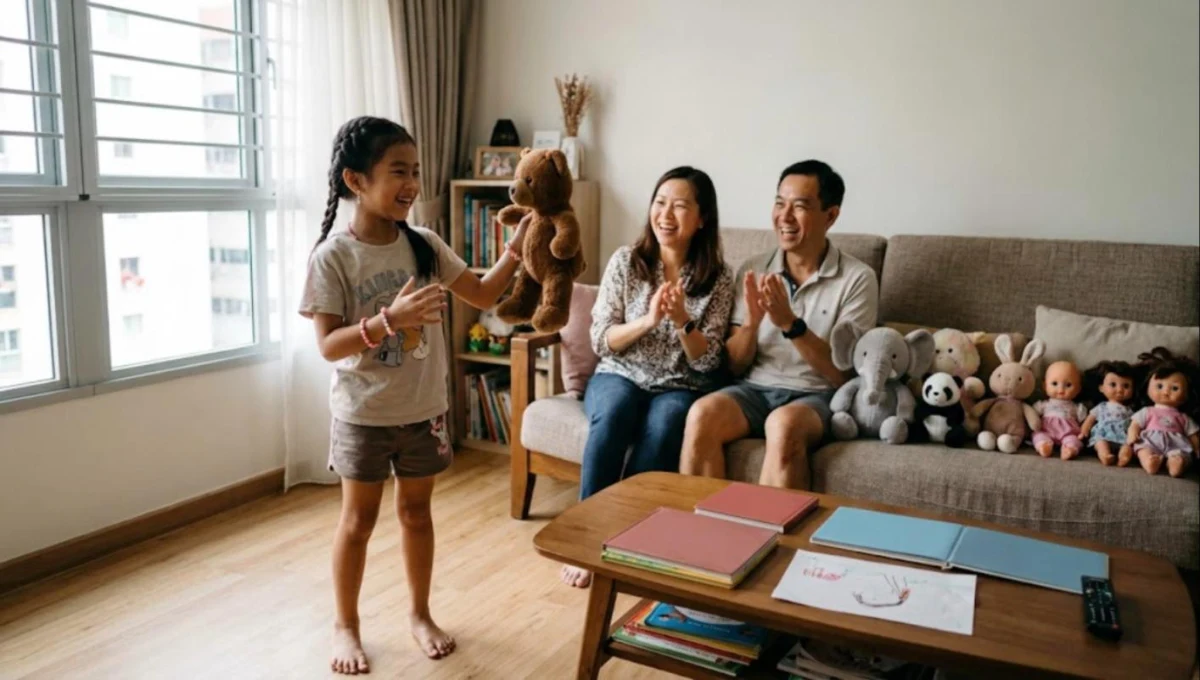
Primary 1 Show and Tell is a short talk where your child brings a favourite item to class and speaks about it in front of their classmates. To prepare, help your child pick an item they love, plan three or four simple points, and practise at home with a small, friendly audience. Above all, focus on confidence first and words second. At Speech Academy Asia, Primary 1 and 2 children prepare for Show and Tell in our regular public speaking classes. This guide shares the same steps our trainers use.
What Is Show and Tell in Primary 1?
Show and Tell is often a child’s first real taste of public speaking in primary school. Your child stands in front of the class, shows an object and talks about it for a minute or two. After that, classmates may ask a question or two.
Many Singapore primary schools use Show and Tell in English lessons in Primary 1 and 2. Teachers usually set a theme for each term, for example “My Favourite Toy”, “My Family” or “My Superhero”. Some schools link it to the books children read in class. As a result, the topic may change every few weeks, but the skills stay the same.
For a six or seven year old, this is a big moment. Even so, it is also a great chance to build habits that last, such as speaking clearly, looking at people and telling a story in order. These same habits help much later in the PSLE English oral.
How Is Primary 1 Show and Tell Assessed?
Every school sets its own rubric, so always check the guidelines your child brings home. Still, most schools look at a similar set of skills. For example, Si Ling Primary’s Primary 1 English Holistic Assessment Plan lists Show and Tell as one of its oral communication tasks. Here is what teachers commonly look for:
| Area | What the teacher looks for |
|---|---|
| Poise | Standing still and tall, with no swaying or fidgeting |
| Voice | Speaking loudly and clearly enough for the whole class to hear |
| Language | Complete sentences and some describing words |
| Engagement | Looking at the audience and showing interest in the topic |
| Content | Clear points in a sensible order, linked to the item and theme |
Notice that only one of these five areas is about content. In other words, how your child speaks counts just as much as what they say. That is good news, because delivery skills improve quickly with practice.
How Do You Choose the Right Item for Show and Tell?
The best item is one your child already loves talking about. If they chatter about it at dinner, their Primary 1 Show and Tell will be easier to talk about in class. Here are a few things to check before you decide:
- It has a story. A toy from Grandma, a medal from sports day or a shell from a holiday gives your child something to say beyond “It is blue.”
- It fits the theme. If the teacher asks for “My Superhero”, a favourite action figure or a photo of Dad both work.
- It is easy to hold. Your child should be able to hold it up with one hand and still use the other hand to point or gesture.
- It is safe to bring. Avoid anything fragile, valuable or hard to replace. If needed, a photo or drawing of the item is fine.
How Should Your Child Structure a Show and Tell?
Young children remember a talk best when it follows a simple pattern. In our classes, we teach a four-step structure that even a shy six year old can follow:
- Greet and introduce. “Good morning, everyone. Today I am going to show you my teddy bear, Coco.”
- Describe it. Use the 5W1H questions as prompts: What is it? Who gave it to you? Where did it come from? When did you get it? Why do you like it? How do you use it?
- Tell a short story. Share one moment with the item, such as a trip, a birthday or something funny that happened.
- Close with a thank you. “That is why Coco is special to me. Thank you for listening.”
Here is a sample script of about 70 words, which matches the length we aim for with six and seven year olds:
“Good morning, everyone. Today I want to show you my teddy bear. His name is Coco. My grandmother gave him to me on my fifth birthday. Coco is brown and very soft, and he has a red bow. Last year, Coco came with me to the hospital when I had a fever. He made me feel brave. That is why Coco is special to me. Thank you for listening.”
Notice that every sentence is short. In addition, the story about the hospital gives the talk a feeling, which makes it memorable for the audience. Finally, use your child’s own words, even if the grammar is not perfect. Teachers can tell when a script was written by an adult.
What Should Your Child Remember on the Day?
Before every Primary 1 Show and Tell in our classes, children say four reminders out loud together. They are short enough for a six year old to remember on the spot:
- Stand straight. Feet still, shoulders back, no swaying.
- Loud voice. Speak so the friend at the back of the class can hear.
- Hand gestures. Hold up the item, point to parts of it and use your hands to show size or shape.
- Eyes on your audience. Look at different friends, not at the floor or the ceiling.
These reminders come from our B.E.S.T Model™, which breaks speaking down into Body language, Emotions, Sentence structure and Tonality. For young children, we keep it simple. Once these four habits feel natural, everything else becomes easier.
How Can You Help Your Child Practise at Home?
Primary 1 Show and Tell practice should feel like play, not homework. Short, fun sessions over a week work much better than one long rehearsal the night before. Try these ideas:
- Build a toy audience. Line up teddy bears and dolls on the sofa. In class, we use a Talking Bear that gets passed around, so a soft toy audience feels familiar.
- Film it on your phone. Our students film their speeches as monthly homework. Watching the video together helps your child see what to improve without you needing to point it out.
- Invite the family. Grandparents, siblings and helpers make a real but friendly audience. Ask them to clap and ask one easy question at the end.
- Ask three reflection questions. After each try, ask: What did you learn? What did you enjoy? What can you do better next time? We end every class with these same questions.
- Practise with the real item. Holding the actual toy or photo helps your child remember what comes next.
Keep each session to about ten minutes. Also, praise one specific thing every time, such as “Your voice was so clear when you said Coco’s name.” Specific praise tells your child exactly what to repeat.
What If Your Child Is Shy or Nervous?
Feeling nervous before Primary 1 Show and Tell is completely normal. The goal is not to remove the nerves but to help your child feel ready anyway. Our trainers use a few simple tools drawn from Neuro Somatics™, our approach to calming the body before speaking:
- Stretch first. Before class presentations, our children do a quick stretching warm-up. Moving the body releases tension and gets the energy flowing.
- Breathe like a balloon. Ask your child to breathe in slowly through the nose, filling the tummy like a balloon, then breathe out slowly. Three breaths are enough.
- Start small. Let your child present to one person, then two, then the whole family. Each small win builds courage for the next.
- Praise effort, not perfection. Celebrate the fact that they stood up and tried. In our classes, children earn stickers and small rewards for effort, not just for a polished talk.
If your child still refuses to practise, do not force it. Instead, try again the next day with a toy audience. Pressure tends to make shy children quieter, while patience helps them open up.
What Are the Most Common Primary 1 Show and Tell Mistakes?
After years of watching children present, our trainers see the same few mistakes again and again. Fortunately, each one has a simple fix.
| Common mistake | Simple fix |
|---|---|
| Hiding behind the item | Hold the item to the side, at chest height, so your face stays visible |
| Talking too softly | Practise speaking to the “friend at the back”, for example a toy placed across the room |
| Rushing through the talk | Pause and take a breath after each point |
| Reading or reciting an adult’s script | Use your child’s own words and three or four key points |
| Only describing the item | Add one short story or feeling about why it is special |
| Forgetting to end properly | Practise the closing line until it is automatic: “Thank you for listening.” |
How Does Speech Academy Asia Help with Show and Tell?
Many parents first come to us because of Primary 1 Show and Tell. In fact, Primary 1 and 2 children prepare for it as part of our regular public speaking classes for kids, so there is no separate course to sign up for. For our six and seven year olds, Show and Tell is the main focus from January to March, alongside topics such as introducing yourself and talking about your dream job.
In class, your child will:
- Practise speaking every lesson, in front of a small group of classmates their own age.
- Learn simple techniques from our Speech Linguistic Patterns™ (SLP), a collection of over 1,000 speaking techniques, adapted for young children.
- Build confidence with stretch warm-ups, games and our Talking Bear activity.
- Film a speech for homework and get feedback from their trainer.
- Present to parents at the end of every month, so speaking in front of a crowd becomes normal.
These are the same foundations that later support our PSLE oral classes, so the skills your child builds now keep paying off for years.
Frequently Asked Questions About Primary 1 Show and Tell
How long should a Primary 1 Show and Tell be?
Most Primary 1 Show and Tell talks last about one to two minutes. Your child’s teacher will usually give a time limit or a list of points to cover. In our classes, six and seven year olds aim for around 50 to 75 words, which fits comfortably into that time.
Should my child memorise a Show and Tell script?
Not word for word. Instead, help your child remember three or four key points in order, such as what the item is, where it came from and why it is special. Children who memorise every word tend to freeze if they forget one line. Kids who know their points can keep talking.
What if my child does not have an interesting item?
Any item works if your child has something to say about it. A drawing, a family photo, a stone from a beach trip or a book from the library can all make a great talk. The story behind the item matters far more than its price or size.
Does Show and Tell count towards my child’s results?
Many schools use Show and Tell as part of Primary 1 and 2 holistic assessment. Children get feedback on skills like voice, body language and content instead of a high-stakes exam mark. Check with your child’s school, because the format and rubric differ from school to school.
A good Primary 1 Show and Tell does not need a fancy item or a perfect script. It needs an item your child loves, a simple structure and a few relaxed practice runs at home. Most of all, it needs plenty of encouragement. If you would like your child to build this confidence with a trainer, book a free trial class with us.
👉 Book a Free Trial Class
📲 Call or WhatsApp: 9061 1715
📍 Visit Us: JEM, 52 Jurong Gateway Road, #06-01, Singapore 608550
📧 Email: info@speechacademyasia.com
Free Trial Registration
Empowering 10,000 Kids and Counting: Boost Your Child’s Confidence and Communication Skills with our Free Trial! Our Public Speaking programme builds vital public speaking and interview skills as well as your child's confidence. Equip your child with the ability to overcome stage fright, present themselves confidently and leave a lasting impression. Investing in these skills early can have immense long-term benefits! Register today!