


Communication Classes in Singapore: Building Confident Speakers in Kids
If you’ve ever sat with your child and asked, “Why so quiet in class but so talkative at home?”, you’re not alone.
Many Singapore parents notice the same thing. Children who are full of ideas, but hesitate to speak up in school, presentations, or interviews.
It’s not that they don’t know what to say. It’s that they are still learning how to say it.
That is where communication classes in Singapore are becoming an important part of a child’s development journey.
When knowing the answer is not enough anymore
Singapore students are often strong academically. They can memorise, calculate, and write well.
But school life today asks for more than just correct answers.
From oral exams to classroom presentations and DSA interviews, students are expected to explain their thinking clearly and confidently under pressure.
This is where many children struggle, not because they lack knowledge, but because they lack structure and confidence in expression.
Communication training helps children turn thoughts into clear, organised speech, even when they are nervous or unsure.
The “quiet at school, noisy at home” reality
This is one of the most common concerns from parents in Singapore.
A child may confidently talk about games, stories, or daily life at home, but become silent when asked to present in front of classmates.
This difference is usually not personality. It is environment.
Communication classes help bridge that gap by creating a safe space where children can practise speaking without fear of being judged or “wrong”.
Over time, they begin to:
- Speak more comfortably in front of peers
- Organise their thoughts before talking
- Respond more naturally during Q&A situations
- Participate more actively in class discussions
Confidence grows through repetition, not pressure.
What actually happens in communication classes?
Forget stiff speeches and memorised scripts.
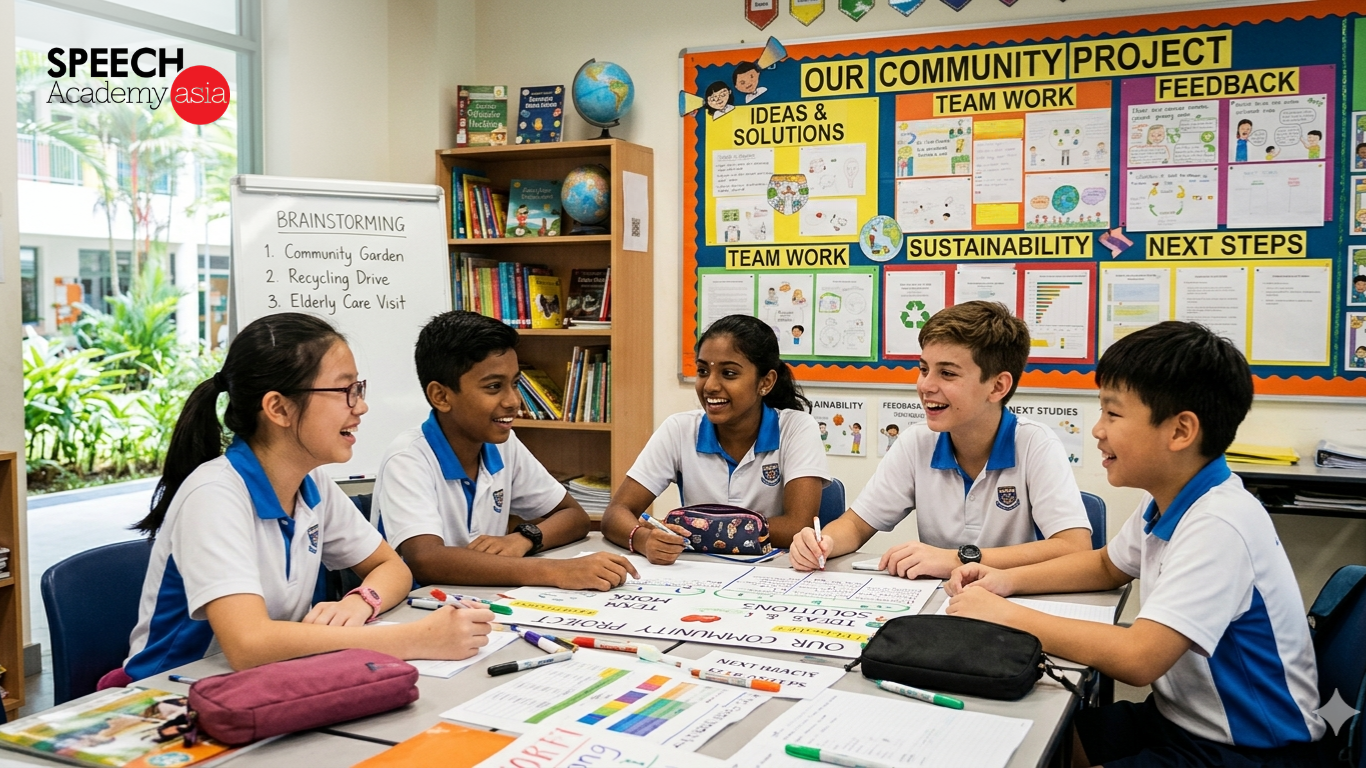
Good communication classes for children in Singapore are usually interactive, lively, and full of movement and expression.
Students may:
- Tell stories using facial expression and gestures
- Practise speaking on the spot without preparation
- Work in pairs to present ideas creatively
- Learn how to vary tone, pace, and volume
- Take part in role-playing everyday situations like interviews or introductions
The goal is not to make children sound perfect.
It is to help them sound clear, natural, and confident.
And yes, there is usually a lot of laughter when children try dramatic storytelling for the first time.
A hidden advantage in DSA and school interviews
For many parents, DSA is no longer just about grades or portfolios.
Schools are increasingly looking at how students carry themselves, how they think on their feet, and how they communicate under pressure.
A child who can:
- Introduce themselves naturally
- Explain their experiences clearly
- Handle unexpected questions calmly
will always stand out in an interview setting.
Communication classes help children practise exactly that, without the pressure of a real selection panel watching.
Not just for future “public speakers”
There is a common misunderstanding that communication training is only for children who want to become leaders, performers, or debate champions.
In reality, it is for every child.
Because no matter what path they take in life, they will need to:
- Share ideas in group projects
- Present in school or work
- Express opinions respectfully
- Communicate with different types of people
Strong communication is not a niche skill. It is a life skill that quietly supports everything else.
Why parents are starting earlier in Singapore
More parents are introducing communication training at a younger age, sometimes even in lower primary or preschool years.
The reason is simple.
Younger children:
- Learn through play more easily
- Are less afraid of making mistakes
- Build speaking habits naturally over time
Instead of waiting until oral exams or DSA preparation, parents are choosing to build comfort with speaking early.
It becomes less about “fixing a weakness later” and more about building confidence steadily over time.
What Are Communication Classes?
Communication classes teach children to organise their thoughts, speak clearly, listen actively and adjust how they speak to different people. They include public speaking, but they also cover conversation, teamwork, storytelling and answering questions on the spot.
Public speaking focuses on speaking to an audience. Communication covers every interaction a child has, from asking a teacher for help to explaining a project to a group. A good class builds both together.
Why Do Children Who Know the Answer Still Struggle to Say It?
Many students already know the answer. What trips them up is organising it quickly. Trainers often see children who:
- Give a correct answer that comes out jumbled
- Lose their point halfway through a sentence
- Speak too fast or too softly when they feel pressure
- Only join in when a teacher calls on them
These are usually gaps in structuring ideas rather than shyness. That is why good communication classes teach children to think in simple structures before they speak, such as beginning, middle and end for younger children, or a point followed by a reason and an example for older ones.
Communication Classes for Different Age Groups
Ages 3 to 6
Young children practise speaking in full sentences, listening and taking turns, and sharing stories through role play and show and tell. For this age group, our speech and drama classes and preschool public speaking programmes build expression through play.
Ages 7 to 12
Primary school brings presentations, group discussions, oral exams and competitions. Children learn to present ideas clearly, structure their answers and tell a story well. These skills also support the PSLE English Oral, which is now worth 40 marks, or 20% of the English score, and DSA interviews. Students preparing specifically for oral exams can join our oral classes.
Ages 13 to 16
Teenagers handle project work, interviews, leadership roles and debates. Classes at this stage focus on persuasive speaking, thinking on their feet and presenting research or data with confidence.
Signs Your Child May Benefit From a Communication Class
- They feel nervous speaking in front of others
- They avoid answering questions in class
- They speak too softly to be heard
- They struggle to organise their thoughts when asked something
- Presentations or interviews make them very anxious
- They find it hard to share an opinion, even with friends
What Should You Look for in a Communication Class in Singapore?
- A progressive curriculum, not a series of unconnected activities
- Experienced trainers who give specific feedback rather than general praise
- Real speaking practice in every lesson, not just theory
- Age-appropriate lessons, since a 7-year-old and a 15-year-old learn very differently
- A way to track progress, such as grading or certification
- Chances to use the skills for real, such as presenting to parents or speaking to members of the public
At Speech Academy Asia, classes follow the 10-Year Series of Public Speaking™ curriculum, which builds skills level by level:
- Level 1, Speech Fundamentals: students learn the 12 speaker archetypes and focus on one body language skill each month.
- Level 2, Real-life Application: every month, students speak with members of the public on that month’s topic.
- Level 3, Coaching Excellence: students take on the role of coach and run a short workshop for parents.
- Level 4, Mass Communication: students learn to communicate through video podcasts, with a focus on digital etiquette.
- Level 5, Research and Development: students run a small research project and present their findings in a TED-style talk.
Why Do Communication Skills Matter Beyond School?
Employers consistently rank communication among the most important skills for new graduates, according to the National Association of Colleges and Employers. A survey by the American Association of Colleges and Universities also found a gap between how much employers value oral communication and how prepared they feel graduates are. Building these skills in childhood gives children years of practice before it counts.
5 Ways to Practise Communication at Home
- Start with a confident greeting. Teach your child to smile, greet their audience and say what they will talk about.
- Slow down. Ask them to pause between ideas, as if having a conversation instead of racing through lines.
- Understand, don’t memorise. When children know their key points, they can explain them in their own words and recover if they forget a line.
- Use beginning, middle and end. This simple structure keeps younger children focused and easy to follow.
- Practise in everyday moments. Ask them to share what they learnt in school, explain how to play a game or recommend a book at dinner.
Frequently Asked Questions About Communication Classes
What age should children start communication classes?
Children can start from 3 years old, with activities such as storytelling, role play and show and tell that suit their age.
Are communication classes the same as public speaking classes?
Not exactly. Communication classes include public speaking but also cover listening, conversation, teamwork and thinking on the spot. Public speaking focuses on speaking to an audience.
Can communication classes help shy children?
Yes. With small steps, regular practice and encouraging feedback, shy children become more comfortable speaking and sharing their ideas.
Are communication classes only for shy children?
No. Confident children also benefit from learning to structure their ideas, persuade others and lead discussions.
Helping children grow into confident communicators
At its core, communication training is not about changing a child’s personality.
It is about unlocking expression.
Helping a quiet child speak up when they have something to say.
Helping a talkative child structure their thoughts better.
Helping all children feel that their voice is valid and worth hearing.
Because in a world full of noise, clarity and confidence in expression will always stand out.
Final thought
Every child already has ideas, opinions, and stories inside them.
The difference lies in whether they feel ready to share them.
Communication classes in Singapore give children that bridge between thinking something and confidently saying it out loud.
And sometimes, that simple ability becomes the foundation for opportunities far beyond the classroom.
Book a Free Trial Class
Call or WhatsApp: 9061 1715
Visit Us: JEM, 52 Jurong Gateway Road, #06-01, Singapore 608550
Email: info@speechacademyasia.com
Free Trial Registration
Empowering 10,000 Kids and Counting: Boost Your Child’s Confidence and Communication Skills with our Free Trial! Our Public Speaking programme builds vital public speaking and interview skills as well as your child's confidence. Equip your child with the ability to overcome stage fright, present themselves confidently and leave a lasting impression. Investing in these skills early can have immense long-term benefits! Register today!