


Learning Public Speaking with AI: How Students Can Use ChatGPT to Become Better Speakers
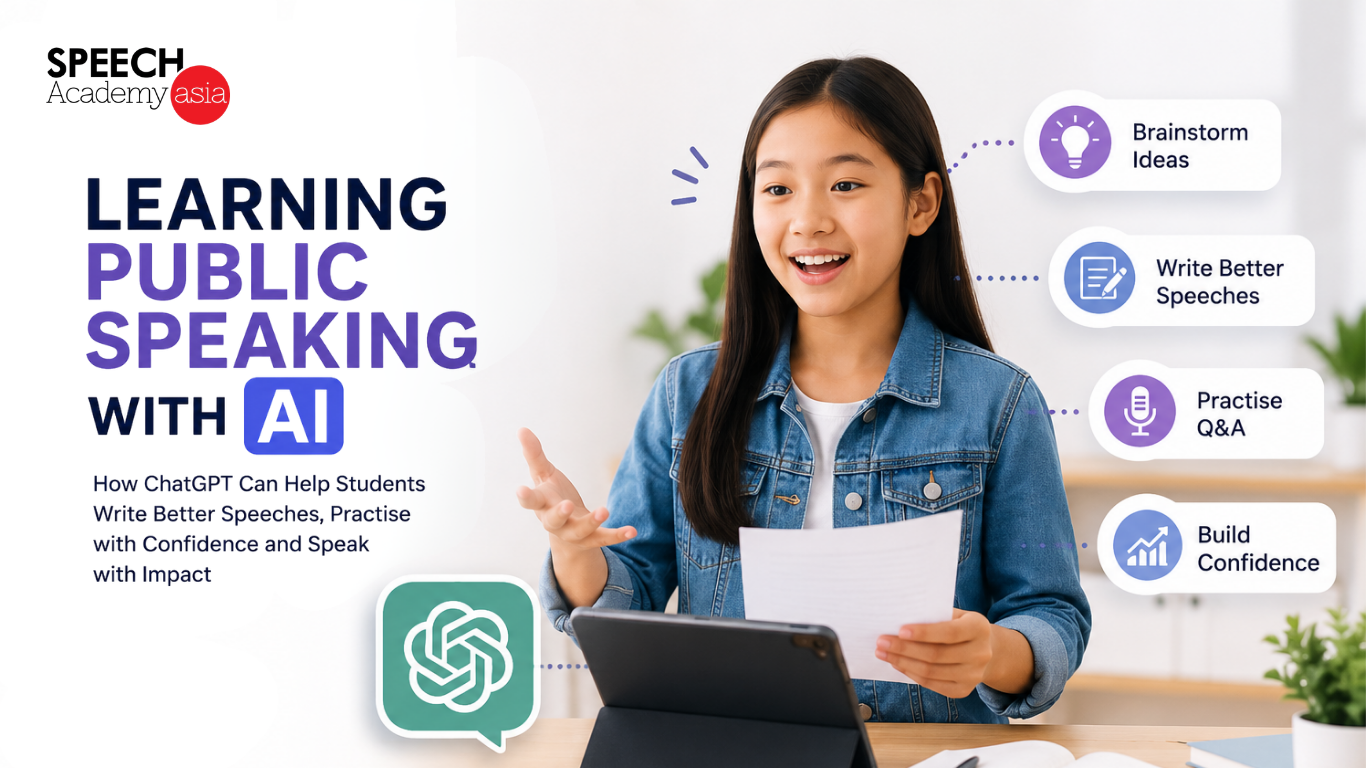
Public speaking is a skill that improves with practice. While traditional public speaking classes and real-world speaking opportunities remain important, technology is creating new ways for students to practise, prepare and build confidence.
One increasingly useful tool is artificial intelligence (AI). With tools such as ChatGPT, students can get help brainstorming ideas, organising speeches, improving scripts and preparing for different speaking situations.
However, learning public speaking with AI should not mean letting AI do all the work. Instead, students can use AI as a learning assistant while developing their own ideas, voice and communication skills.
What Does Learning Public Speaking with AI Mean?
Learning public speaking with AI means using AI tools to support different stages of the speaking process, from coming up with an idea to practising a presentation.
For example, a student preparing a school presentation could use ChatGPT to:
-
Brainstorm possible speech topics
-
Organise ideas into a clear structure
-
Suggest ways to improve a speech opening
-
Simplify complicated sentences
-
Generate questions an audience might ask
-
Practise answering unexpected questions
-
Review a speech for clarity and flow
-
Suggest alternative ways to express an idea
The important part is that the student remains the speaker.
AI can provide suggestions, but students still need to decide what they want to say, understand their topic and practise delivering their message.
1. Use ChatGPT to Brainstorm Speech Ideas
One of the hardest parts of preparing a speech can be deciding what to talk about.
Instead of asking ChatGPT to write an entire speech, students can use it to generate ideas.
For example, a student could ask:
“Give me five interesting speech topics for a Primary 5 student who enjoys animals.”
The student can then choose a topic that genuinely interests them.
This is useful because a good speech starts with an idea that the speaker understands and cares about. AI can help students explore possibilities, but the final choice should come from the student.
2. Use AI to Build a Speech Structure
Once students have a topic, they can ask ChatGPT to help organise their thoughts.
A simple speech structure could include:
Opening → Main Point 1 → Main Point 2 → Main Point 3 → Conclusion
Students can ask AI questions such as:
“Help me organise these ideas into a three-minute speech.”
This can help students understand how different points connect and whether their speech has a clear beginning, middle and ending.
Rather than copying the suggested structure word-for-word, students should adapt it to suit their own ideas and speaking style.
3. Use ChatGPT to Improve a Speech Script
AI can also be useful when a student already has a draft.
For example, instead of asking:
“Write my speech for me.”
A better prompt would be:
“Here is my speech. Can you identify sentences that are difficult to understand and suggest simpler alternatives while keeping my original ideas?”
This encourages students to learn from the editing process.
They can compare their original wording with the suggested version and consider why one sentence might sound clearer or more natural.
This is particularly useful for students who are still developing their vocabulary or learning how to structure their ideas.
4. Practise Different Speaking Situations
Public speaking is not only about delivering a prepared speech.
Students may also need to answer questions, participate in discussions, give presentations or speak spontaneously.
AI can help students prepare for these situations.
For example:
“Pretend you are an audience member listening to my presentation about climate change. Give me five questions I might be asked.”
The student can then practise answering each question.
They can also ask ChatGPT to provide follow-up questions, helping them think beyond memorised answers.
This can be a useful way to develop thinking on your feet, an important part of confident communication.
5. Learn How to Make a Speech More Engaging
Students can also use AI to explore different ways of presenting the same idea.
For example, they could ask:
“Give me three different ways to start a speech about friendship: one using a question, one using a short story and one using an interesting fact.”
This allows students to see how different openings can create different effects.
They can then decide which approach feels most natural for them.
The goal is not to sound like AI. The goal is to understand why certain speaking techniques work and eventually use them independently.
6. Use AI for Public Speaking Practice, Not Just Writing
One of the biggest mistakes students can make is using AI only to generate scripts.
Public speaking is ultimately a performance skill.
A beautifully written speech will not automatically make someone a confident speaker.
Students still need to practise:
-
Voice projection
-
Pace and pauses
-
Pronunciation
-
Eye contact
-
Facial expressions
-
Gestures
-
Posture
-
Audience engagement
-
Speaking without relying completely on notes
After preparing a speech with AI, students should put the screen away and say the speech out loud.
Even better, they can practise in front of a parent, teacher, friend or public speaking trainer and receive feedback.
7. Ask AI to Challenge Your Ideas
AI can also be used as a discussion partner.
Suppose a student is preparing a persuasive speech about whether students should have more homework.
Instead of simply asking AI to write arguments, the student could ask:
“Give me three arguments against my opinion so I can practise responding to them.”
This encourages students to consider different perspectives.
They can then practise responding clearly and respectfully, rather than simply memorising one side of an argument.
This type of preparation can help develop critical thinking, adaptability and confidence during discussions.
What AI Cannot Replace in Public Speaking
Although AI can be a useful learning tool, it cannot replace the human aspects of public speaking.
A student still needs real opportunities to communicate with other people.
Speaking in front of an audience teaches students how to:
-
Read audience reactions
-
Adjust their delivery
-
Manage nervousness
-
Respond naturally to questions
-
Connect emotionally with listeners
-
Communicate using voice and body language
These skills develop through actual human interaction and repeated practice.
AI can help a student prepare. Real speaking experiences help the student perform.
How Parents Can Encourage Responsible Use of AI
Parents can help children use AI productively by encouraging them to treat it as a learning assistant rather than an answer machine.
A useful approach is:
- Think first.
Ask your child to come up with their own ideas before turning to AI. - Ask AI for guidance.
Use prompts that request feedback, questions, suggestions or improvements rather than asking AI to complete the entire assignment. - Check the information.
AI-generated information can sometimes be inaccurate, so important facts should be checked against reliable sources. - Make it their own.
Children should understand and be able to explain anything they include in a speech. - Practise offline.
Once the preparation is complete, put the device aside and practise speaking aloud.
This approach allows children to benefit from technology while continuing to develop independent communication skills.
The Future of Public Speaking Is Human + AI
AI is changing how students learn, research and prepare for presentations. Used thoughtfully, tools such as ChatGPT can make public speaking practice more accessible and interactive.
But confidence cannot simply be generated by a chatbot.
Students need to develop their own thoughts, find their own voice and gain experience communicating with real people.
That is why the most effective approach to learning public speaking with AI is not AI instead of public speaking training. It is AI alongside meaningful practice, coaching and real-world speaking opportunities.
At Speech Academy Asia, students develop public speaking and communication skills through structured learning, guided practice and opportunities to speak with confidence. AI can be a useful addition to that learning journey, but the most important skill remains the same: having the confidence to stand up and make your voice heard.
Frequently Asked Questions
Can ChatGPT help children learn public speaking?
Yes. ChatGPT can help students brainstorm ideas, organise speeches, improve scripts, generate practice questions and explore different ways to communicate an idea. However, students should use it as a learning tool rather than relying on it to write everything for them.
Can ChatGPT write a public speaking script?
ChatGPT can help generate a draft, but students benefit more when they develop their own ideas first and use AI to improve structure, clarity and wording. This helps ensure the final speech reflects the student’s own understanding and voice.
Is AI enough to become a confident public speaker?
No. AI can support preparation, but confidence develops through actual speaking practice, feedback and experience communicating with an audience.
How can students use ChatGPT to practise public speaking?
Students can ask ChatGPT to generate audience questions, challenge their opinions, suggest different speech openings or create mock discussion scenarios. They should then practise answering aloud rather than simply reading the responses.
Should parents allow children to use AI for school speeches?
Parents can encourage responsible AI use by guiding children to use AI for brainstorming, feedback and practice rather than simply copying AI-generated content. Children should understand, verify and personalise anything they use in their presentations.
👉 Book a Free Trial Class
📲 Call or WhatsApp: 9061 1715
📍 Visit Us: JEM, 52 Jurong Gateway Road, #06-01, Singapore 608550
📧 Email: info@speechacademyasia.com
Free Trial Registration
Empowering 10,000 Kids and Counting: Boost Your Child’s Confidence and Communication Skills with our Free Trial! Our Public Speaking programme builds vital public speaking and interview skills as well as your child's confidence. Equip your child with the ability to overcome stage fright, present themselves confidently and leave a lasting impression. Investing in these skills early can have immense long-term benefits! Register today!