


Communication Class for Students in Singapore: What to Look For and Why It Matters
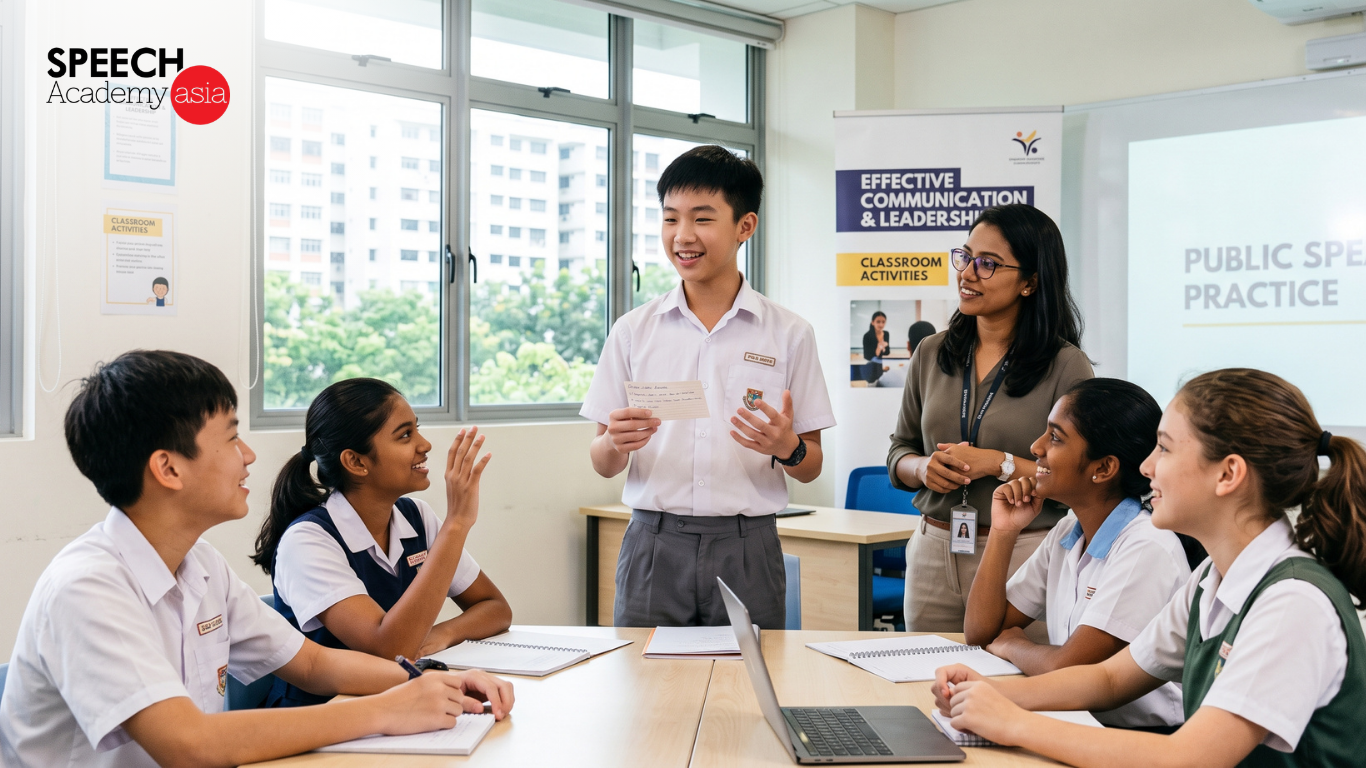
“My child knows the answer in class but freezes when the teacher asks them to explain it out loud.” If this sounds familiar, you are not alone. Many Singapore parents start looking for a communication course for students for exactly this reason. Their child has ideas, but struggles to express them clearly and confidently.
A good communication course does more than teach students to speak nicely. It builds the everyday skills students need to express themselves, listen actively, work with others and grow in confidence. These are skills that matter in the classroom, in friendships and, eventually, in the workplace.
This guide covers what a communication course for students actually involves, what to look for when choosing one, and how Speech Academy Asia’s (SAA) programmes are structured to build these skills progressively.
What Is a Communication Course for Students?
A communication course for students is a structured programme that teaches learners how to express ideas clearly, listen actively, use body language effectively and adapt their communication to different situations and audiences.
Unlike a one-off workshop, a proper course builds these abilities progressively over time through:
- Guided speaking practice (presentations, storytelling, discussions)
- Structured feedback from trainers
- Real opportunities to apply the skills, not just learn about them in theory
Communication courses are often grouped with public speaking classes, but the two are related, not identical. We covered the difference in more detail here. In short, communication skills cover everyday interactions like conversations, listening and teamwork, while public speaking focuses specifically on communicating to an audience. A strong communication course usually develops both.
Why Communication Skills Matter for Students
Communication is one of the most consistently in-demand skills employers and educators look for — and one of the skills students are least often taught explicitly in school.
- Employers surveyed by the National Association of Colleges and Employers rank communication as one of the most important career-readiness skills for new graduates.
- A national employer survey by the American Association of Colleges and Universities found that while most employers rate oral communication as very important for new hires, only about a third feel recent graduates are genuinely well prepared in this area.
This gap between how important communication is and how well it’s actually taught is exactly why starting early matters. Students who build these skills as children and teenagers. Rather than trying to catch up as young adults, they get to enter school presentations, interviews, and eventually the workplace with a real head start.
What to Look For in a Communication Course for Students
Not all communication courses are built the same way. Here’s what to check before enrolling:
- Structured, progressive curriculum: Not a series of unconnected activities, but a clear pathway from foundational skills to advanced application.
- Trained, experienced trainers: Able to give specific, constructive feedback rather than generic praise.
- Real speaking practice: Presentations, discussions, storytelling and impromptu speaking, not just theory.
- Age-appropriate content: A 7-year-old and a 15-year-old need very different lesson approaches.
- A way to track progress: Formal assessment or certification gives both students and parents a clear sense of growth.
- Opportunities to apply skills in real settings: The classroom, community or online, not just within the course itself.
How Speech Academy Asia’s Communication Courses Are Structured
At Speech Academy Asia, communication and public speaking training follows a 10-Year Series of Public Speaking™ curriculum, built across five progressive levels so that students develop skills systematically rather than all at once.
Our Methodologies
- The Speech Linguistic Patterns™ (SLP™) is our system of over 1,000 techniques modelled after top speakers, covering everything from voice tonality and body language to persuasive structure.
- The Language Memory Programming Semantics™ (LMPS™) uses movement and emotional feedback to help students apply communication skills to real-life situations, such as handling school challenges and relationships.
- The Neuro Somatics™ combines speech training with neuro-body science to support emotional intelligence and stress management alongside communication skills.
How Progress Is Built and Measured
- Grading certification: Students are formally assessed each quarter and progress through Grades 1 to 8 under senior trainers.
- Monthly live presentations: Students showcase their progress in front of parents and invited guests.
- Weekly outdoor speaking sessions: Supervised practice engaging with the public to build real-world courage.
- Level 2 real-life application projects: Students apply their skills through activities such as running a community donation drive, planning a bazaar, or leading peer study groups.
- Level 4 Mass Communication: Older students learn to create podcasts, host talk shows and deliver news reports, applying communication skills to media and current issues.
- Level 5 Research & Development: Students conduct research, evaluate sources and present Final Year Projects, combining communication with critical thinking.
Why Parents and Schools Trust SAA
Speech Academy Asia was founded by Kelvin Tan and Lukas Seet. Lukas is a certified NLP Master Practitioner who has trained individuals in public speaking and leadership since 2003, and Kelvin is a master trainer and former competitive storyteller. Since then, SAA has:
- Worked with 300+ MOE schools across Singapore
- Been featured on Mediacorp (CNA, 938LIVE, Suria), The Straits Times, and theAsianParent
- Received industry recognition, including the FLA Franchisor of the Year Award and Promising SME500
- Delivered training recognised alongside examination bodies such as Trinity College London and LAMDA
This combination of a structured methodology, trained professionals and a track record with schools is what allows SAA to run communication courses that go beyond generic confidence-building exercises.
Frequently Asked Questions
What age can a child start a communication course?
Children can start as young as preschool age, with lesson content adjusted for their developmental stage. At Speech Academy Asia, Level 1 of the 10-Year Series is designed to be age-appropriate for younger learners, while later levels introduce more advanced applications for teenagers.
Is a communication course the same as a public speaking class?
Not exactly. Communication skills cover a broader range of everyday interactions, including listening, conversation and teamwork, while public speaking focuses specifically on communicating to an audience. Most effective courses, including SAA’s, develop both together.
How long does it take to see improvement?
Many parents notice initial improvements in confidence and clarity within a few months of consistent practice. We aim to teach deeper, lasting communication skills such as persuasive speaking, leadership communication and handling real-world situations. These skills typically develop over a longer, structured programme, which is why SAA’s curriculum is designed as a multi-year pathway rather than a short course.
Can communication courses help with school presentations and oral exams?
Yes. Structured speaking practice directly supports classroom presentations, group projects and oral examinations. We have a proven system to teach students how to structure ideas clearly, improve voice projection, and build confidence under pressure.
What should I look for when comparing communication courses in Singapore?
Look for a progressive curriculum, experienced trainers, regular opportunities to practise speaking, a way to track progress, and a course that is age-appropriate for your child’s stage of development.
Help Your Child Become a Confident Communicator
A good communication course does more than help a student speak in public. It gives them the tools to express ideas clearly, listen actively, and communicate with confidence in the classroom, at home and beyond.
At Speech Academy Asia, our Public Speaking Programmes for Kids & Teens are built on a structured, 10-year curriculum trusted by over 300 MOE schools across Singapore.
Learn more about Communication Courses or visit Speech Academy Asia to explore our programmes and find out how we can support your child’s communication journey.
👉 Book a Free Trial Class
📲 Call or WhatsApp: 9061 1715
📍 Visit Us: JEM, 52 Jurong Gateway Road, #06-01, Singapore 608550
📧 Email: info@speechacademyasia.com
Free Trial Registration
Empowering 10,000 Kids and Counting: Boost Your Child’s Confidence and Communication Skills with our Free Trial! Our Public Speaking programme builds vital public speaking and interview skills as well as your child's confidence. Equip your child with the ability to overcome stage fright, present themselves confidently and leave a lasting impression. Investing in these skills early can have immense long-term benefits! Register today!